

Borderline Personality Disorder : More Than A Diagnosis

After my last article, a lot of people have been in touch to ask me questions about BPD so I thought I would write this article to help explain what it is exactly…
When people hear the word Borderline Personality Disorder (BPD or Emotionally Unstable Personality Disorder), they often picture the stereotypes that they’ve seen online or on TV.
The reality is far more complex than that…
BPD isn’t about being “too dramatic”, “attention seeking”, or “too emotional”. It’s a recognised mental health condition that affects the way some people experience emotions, relationships, and even how they view themselves.
For many people, emotions don’t simply come and go, they can feel intense, overwhelming, and incredibly difficult to regulate.
So here’s the important stuff…
What Can BPD Feel Like?
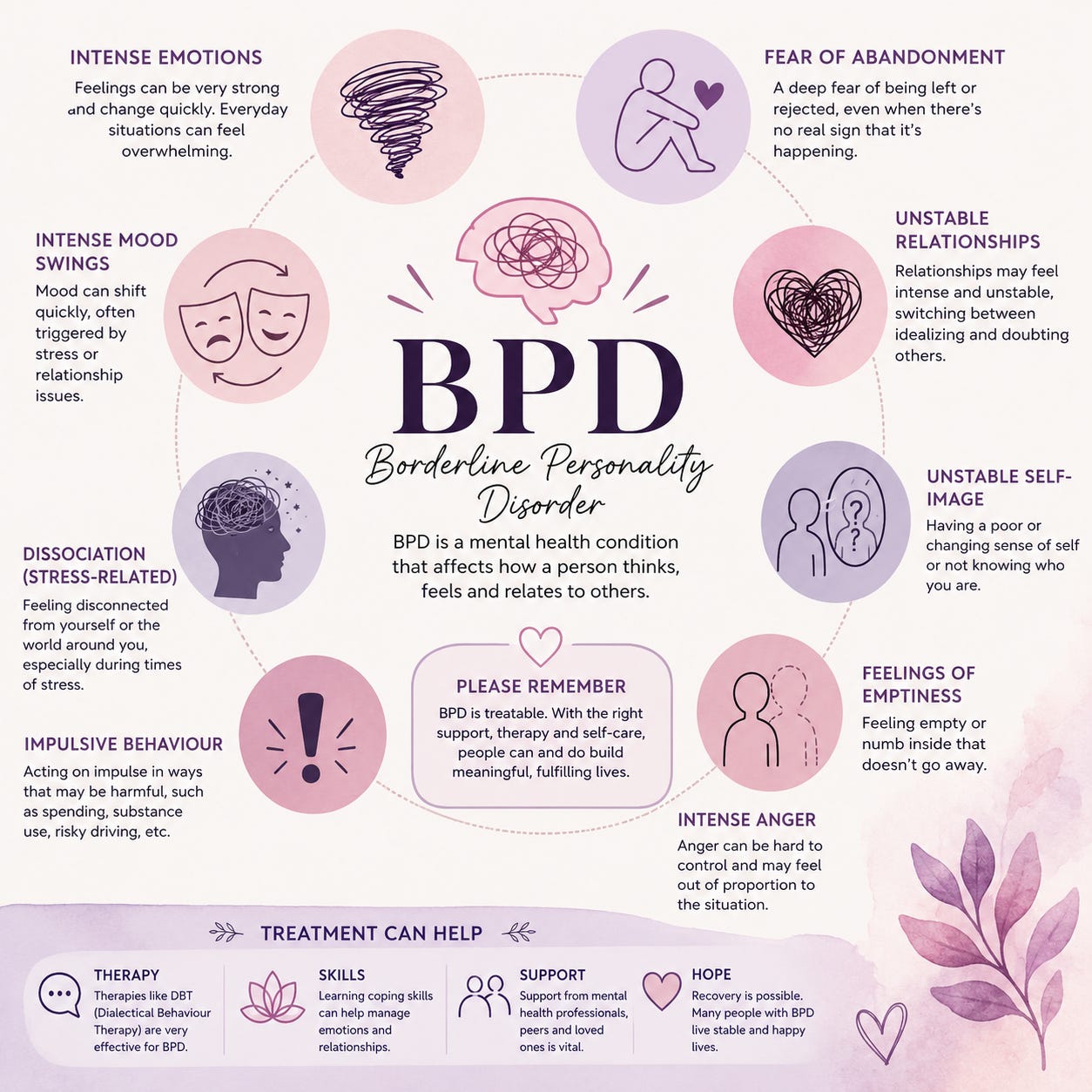
Everyone experiences BPD differently but some common experiences include:
Intense emotions that very quickly change in a short time frame
A deep fear of rejection or abandonment, whether real or perceived
Difficulty maintain stable relationships
Feeling unsure about who you are as a person or having a change of identity
Chronic feelings of emptiness
Intense anger that can be difficult to manage
Impulsive behaviours
Feeling disconnected from yourself or your surroundings during times of stress (sometimes called dissociation).
Rapid changed in how you view yourself and / or other people.
Not everyone with BPD will experience these symptoms, and the symptoms can change over time.
How Can It Affect Daily Life?
Living with BPD can be exhausting!
A disagreement that someone else might recover from in a few minutes, can stay with you for hours or days.
A delayed reply to a message may trigger intense anxiety.
You might replay conversations over and over again, wondering if you’ve said the wrong thing.
Some days, simply getting out of bed can feel overwhelming because your emotions are already so intense when you wake up.
Relationships can become complicated, not because you don’t care, but because you often care so deeply and will do anything to keep that person close to you.
Many people living with BPD also experience overwhelming guilt after emotional situations, particularly if they feel they’ve upset someone they love.
The emotional exhaustion that follows can be just as difficult as the emotions themselves.
Is There Treatment For BPD?
YES!
Although living with BPD can feel incredibly difficult, it is also one of the most treatable personality disorders.
Recovery doesn’t always mean symptoms disappear completely, but many people find they become less intense and much easier to manage over time.
Treatment may include:
Talking therapies such as Dialectical Behaviour Therapy (DBT), which helps people develop skills in emotional regulation, distress tolerance, mindfulness, and interpersonal effectiveness.
Other psychological therapies, depending on an individual’s needs.
Support from community mental health teams.
Medication to help with co-occurring conditions such as anxiety or depression, when appropriate. There isn’t a medication that specifically treats BPD itself, but medication may be used to help with related symptoms or conditions.
Recovery is rarely a straight line.
There will be setbacks. There will be difficult days but there can also be healing, growth, and hope.
Many people living with BPD build meaningful relationships, pursue careers, raise families, and create fulfilling lives.
A diagnosis doesn’t define who you are.
It’s simply one part of your story.
If you need support
If you think you may have symptoms of BPD, or you’ve recently been diagnosed, you don’t have to navigate it alone.
Below are some trusted organisations and resources that provide information and support.
A close friend of mine with BPD said brain spotting helped her a lot. I ended up doing it as well and was able to work through a lot more than with just talk therapy.